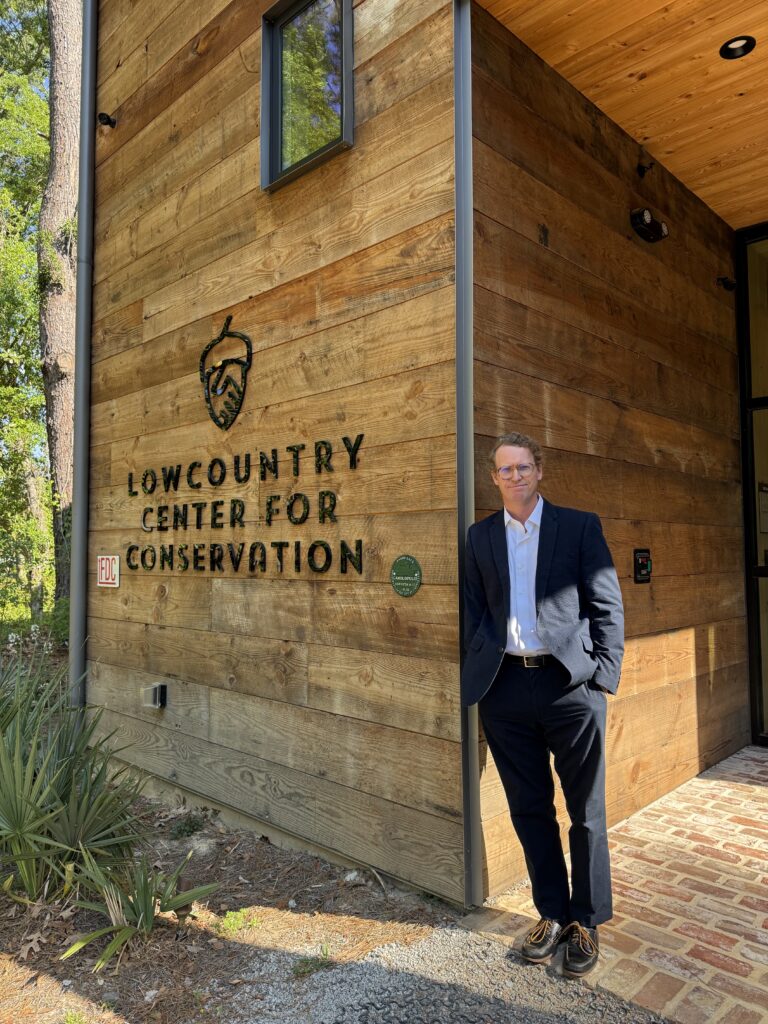
INTERVIEW WITH MATT WILLIAMS
Why do you choose to support Charleston Waterkeeper? How did you get started with us?
One of the most important things we can do in conservation is connect people with nature, and we need to provide as many opportunities as we can for folks to get out and experience our natural places. When you take your kids or family into nature, it needs to be in a safe way. Clean water that we can swim in, catch fish in, or pick oysters in is really important to our overall livelihoods and supportive to our sense of place, and clean water makes Charleston a livable place. It’s really important to support groups like Charleston Waterkeeper that are making sure we know when and where we’re experiencing clean and safe water.
What is your favorite way to enjoy clean water?
I love to recreate in the waters around Charleston County on the weekends with my kids. We like to fish and to swim, so it’s nice to recreate in places where I know the water is clean. If I catch a fish and I decide I want to keep it for supper–which isn’t often–but when I do, I like to catch that fish and know that it’s coming from an estuary with high water quality. And that’s one of the reasons why Charleston Waterkeeper’s work is so important–you let us know where the safe places are to recreate.
Do you have a favorite waterway in Charleston or a memorable experience on the water?
I’m going to go north to talk about my favorite place because I grew up on the Santee Delta, and Charleston County’s and Georgetown County’s line is the South Santee River. I’ve spent all my life recreating and spending time fishing, swimming, and hunting on the Santee Delta. So my absolute favorite waterway in the County is the South Santee River, but I also really enjoy spending time on the Stono River, the Kiawah River, and in the North Edisto River, and I love spending time at Botany Island.
Why is environmental stewardship important to you and why should others become a waterway steward like you?
I have devoted my life to conservation and to protecting the last great places of the South Carolina lowcountry. I live it, I breathe it, and I do this work because I want my kids and future generations of the Lowcountry to have a place where they can connect with nature. I truly believe that time spent in nature with people that you love is the best medicine we can possibly give ourselves.
Tell us about what you’ve been working on or a recent project you’re excited to share.
Lowcountry Land Trust has well over a dozen projects in the pipeline, and these are projects to permanently protect land with either conservation easements or through what we call a fee-simple acquisition, which will then be transferred to a county, state, or federal partner. We have projects from the Savannah River all the way up to Georgetown County in various stages of completion. We are really excited about getting those finished this year. On average, we close about 12-15 projects per year and we average about 3,500 acres of protected land each year.
Tell us something interesting about yourself that we might not know!
I love spending time in nature, but I think my peanut butter and chocolate combination is when I’m in nature with people that I love but also listening to really good music. And just as I love to find new and special places in nature, I also love to find new songs that pique my imagination and make me have a new experience with music that I’ve never had. I’m also a musician and I love to play music, and I play in a band with my brother called Solid Country Gold.
Matt Williams is the President and CEO of Lowcountry Land Trust.